
Six months ago I wrote up my long-term take on the BIG HORN pizza oven, and if you read that piece you got the version where I fell for this thing. This is the other half. Before you spend on a BIG HORN pizza oven, I want to walk through what genuinely annoyed me across roughly forty cooks, the setup that fought me, the hot spot I never fully solved, the fuel switching that is more work than the box photo suggests, and the specific kind of buyer who should just save the trouble and buy something else. Eleven seasons on this deck have made me allergic to gear that oversells itself, and I think the BIG HORN oversells itself in a few specific spots worth knowing before your money leaves your account.
None of what follows means I regret buying it, and I will get to the parts that still work by the end. But too many reviews of outdoor pizza ovens read like they were written after one good Saturday cook, stone glowing, crust blistering, everybody happy. Mine is written after a full spring and summer of near-weekly use on a 12 by 14 back deck, feeding six to eight people most Sundays, and after several cooks that did not go the way the marketing photos promised. If you already read my long-term piece, this is the version with the gloves off. If you have not, I would still start here, because the caveats matter more than the highlight reel when you are the one paying under two hundred dollars for it.
The Quick Verdict
Still a good oven for the price, but the marketing oversells the ease of use and the heat claims. Budget for a real learning curve and some fussing with wind, hot spots, and fuel changeovers before you get consistent pies.
Amazon Check Today's Price →Before you buy, know exactly what you are signing up for.
The BIG HORN pizza oven earns its keep once you learn its quirks, hot spots, wind sensitivity, a manual that skips the details you actually need. Current price on Amazon, and worth reading the honest version before you decide.
Amazon Check Today's Price on Amazon →How I've Used It
I did not get a smooth first week with this oven, and I think that is worth saying plainly. Out of the box, two of the four folding legs did not sit flush against the deck boards, and I spent twenty minutes with a wrench snugging a bolt that had backed out slightly in shipping before the thing would sit level. The BIG HORN's included manual is two pages, mostly diagrams, and it tells you almost nothing about how the wood, gas, and electric setups actually differ in practice, temperatures, timing, technique. Everything I know now about running this oven well, I learned by burning through dough and fuel, not by reading what came in the box.
My first real cook was not the triumphant Neapolitan moment I expected. I loaded the peel, gave it a confident shake toward the mouth of the oven, and the dough round folded over itself halfway in, landing crooked against the back wall of the stone like a taco instead of a pizza. I have launched pizzas onto stones for years on other setups, so that was less about my inexperience and more about how narrow and low the BIG HORN's opening is compared to what I was used to. It took roughly six attempts before I stopped babying the launch and started trusting a faster, more decisive motion.
Across the roughly forty times I have fired this oven, the pattern has held. It rewards confidence and punishes hesitation, and the instructions do nothing to prepare you for that. If you are coming from a regular grill or a kitchen oven and have never worked with a peel and a stone before, plan on your first several pies looking rougher than anything BIG HORN shows in its product photos. That is not unique to this brand, most stone ovens have a learning curve, but the BIG HORN's manual undersells it more than most.
What Nobody Mentions About Setup
The BIG HORN ships with a coating of manufacturing oil on the interior dome that needs a proper burn-off before you cook anything, and this is not clearly flagged anywhere in the included paperwork. I found out from a forum thread, not the box. My first firing produced a sharp chemical smell for about fifteen minutes that had me checking twice whether I had done something wrong. I had not. A slow first burn with no food in it is standard practice for a lot of coated metal cookware, but a single sentence in the manual would have saved me the worry.
Storage is the other setup detail that gets glossed over. The vinyl cover BIG HORN includes does not seal fully at the bottom edge, which is fine in dry weather but let enough moisture in during a rainy stretch in May that I found faint water spotting on the stainless legs. I also left the gas burner attachment port uncovered for about a week between uses and came back to find a small spider had taken up residence inside it. Neither issue affected performance, but both were the kind of small annoyance that a slightly better-designed cover would have prevented.
None of this is disqualifying, but it adds up to a product that needs more attention in its first few weeks than the marketing implies. You are not just unboxing and cooking. You are burning off manufacturing residue, adjusting hardware, finding a storage routine, and learning a launch technique, all before you get a pizza you would actually serve to guests without apologizing for it.
The Uneven Heat Nobody Warns You About
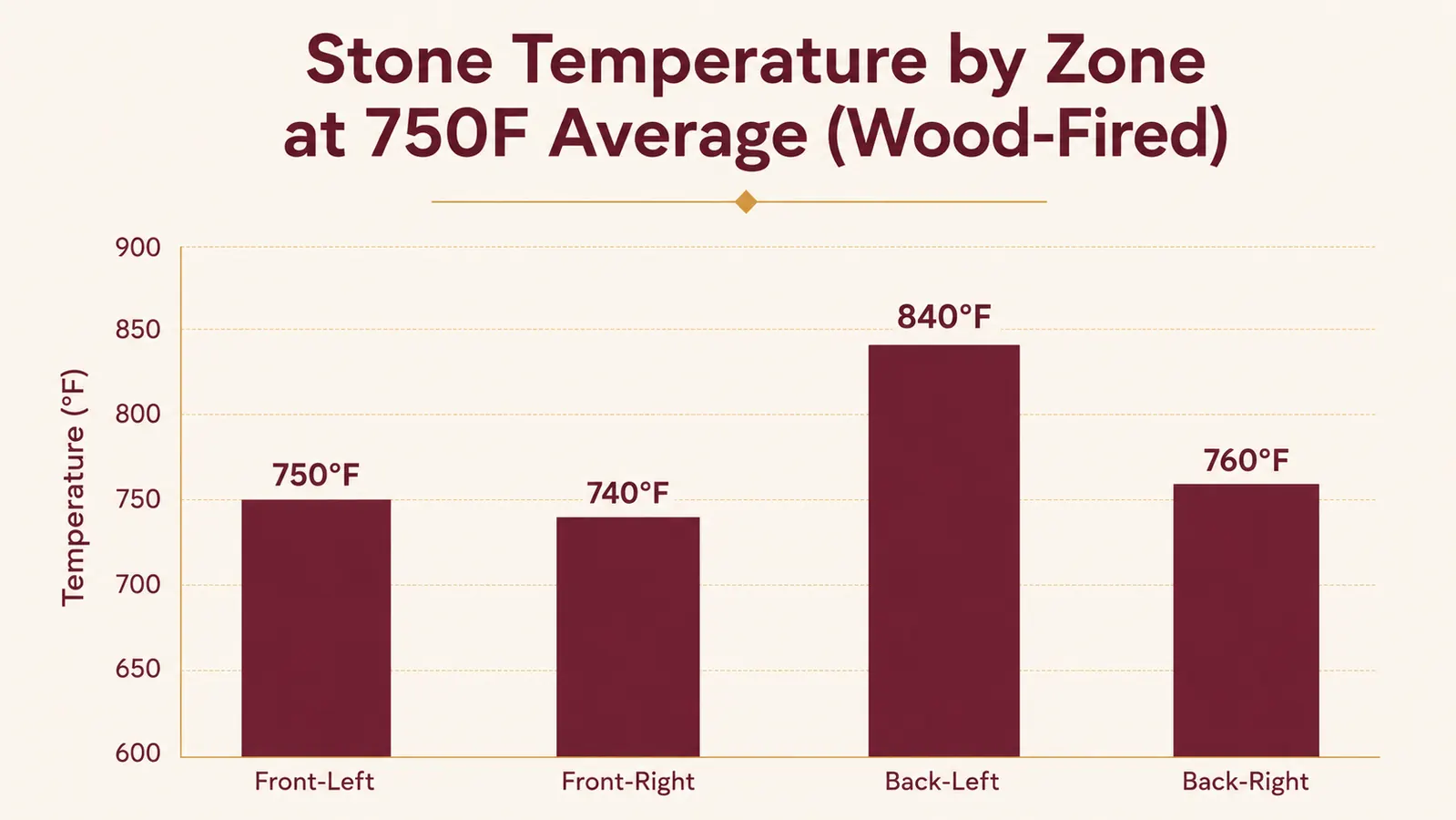
The single biggest gap between the BIG HORN's marketing and my actual experience is heat distribution. The back-left quadrant of the stone consistently runs hotter than the rest, by enough that I can watch a crust blacken on that side while the opposite edge stays pale gold in the same ninety seconds. I did not imagine this. I confirmed it with an infrared thermometer across a dozen preheats, and the gap between the hottest and coolest spot on the stone was routinely 80 to 100 degrees Fahrenheit at a 750°F average reading.
In practice that means rotating every fifteen seconds instead of the twenty I originally planned on, watching the pizza the entire time instead of stepping away to grab a drink, and accepting that some pies will have a slightly darker edge no matter how careful you are. It is a manageable quirk once you know about it. It is also something I never saw mentioned in a single piece of BIG HORN's own marketing copy, which shows even, restaurant-style char in every photo.
Wind makes the hot spot worse. On a gusty evening in April, a steady breeze off the yard dropped my stone temperature by close to 150 degrees in under three minutes and pushed the flame noticeably toward that same back-left corner, deepening the imbalance instead of just cooling things down evenly. I ended up dragging the BIG HORN against the side of my house to break the wind, which worked, but it meant I could not keep it in its usual spot near my 22-inch kettle where I like to run both at once.
These days I check wind speed in the forecast before I light anything, and if gusts are running above roughly 10 miles an hour I plan on repositioning the BIG HORN against the house from the start instead of finding out mid-cook that I need to. That is a habit the manual never suggests and a first-time buyer would have no reason to expect. It is a small routine once you know it, but it is one more thing standing between you and the effortless cook the product photos imply.
Fuel Switching Sounds Simpler on the Box Than It Is
The 3-in-1 wood, gas, and electric pitch is the headline feature, and I do not think it is dishonest, but I do think it undersells the work involved in actually switching between them. Going from wood to electric is not a five-minute swap. You need to let the stone cool enough to handle safely, clear out spent pellets and ash, and then fit the electric coil assembly, a process that has taken me anywhere from ten to fifteen minutes depending on how hot the last fire was.
The gas burner attachment is sold separately from the base oven, which is a detail easy to miss if you are comparing prices at a glance. Between the base unit and the gas attachment, the real cost of running all three fuel types is noticeably higher than the sticker price for the oven alone suggests. If wood-only ownership is fine with you, skip the add-on entirely and save the money. If you want the full 3-in-1 experience the box promises, budget for it as two purchases, not one.
Ash cleanup is the part of fuel switching nobody mentions in the listing photos either. Wood mode leaves a fine gray dust across the base of the oven and, on a breezy night, across the nearest few feet of deck boards. I have taken to keeping a small hand broom next to the BIG HORN just for this, and I sweep it down after every wood cook rather than letting a week of ash build up before it gets tracked into the house on somebody's shoe.
What I Liked
- Once you learn the hot spot, results are genuinely good, close to restaurant char in under two minutes
- Wood mode reaches usable cooking temperature in about fifteen minutes
- Light enough at roughly 22 pounds to actually move to a tailgate or a friend's yard
- Held up structurally through a full spring and summer of near-weekly firing
- Electric mode still lights reliably even when the deck thermometer drops into the teens
Where It Falls Short
- Stone has a real hot spot, roughly 80 to 100 degrees Fahrenheit hotter on one side
- Manual skips basic details like the manufacturing oil burn-off and fuel-switching steps
- Wind sensitivity is worse than any multi-fuel pizza oven I have used before
- Gas burner attachment sold separately adds a real chunk to the true cost
- Included cover does not seal well enough to fully protect it from rain
The BIG HORN never lied to me about what it could do. It just left out most of the details about how much attention it needs to actually do it.
What It Still Does Right
With all of that said, I have not stopped using it, and that matters more than any single complaint on this page. Once I learned the hot spot and started rotating on a tighter schedule, I have turned out consistently good pies, blistered edges, a properly cooked bottom, in well under two minutes each. That is still faster than anything else on my deck, including my small offset smoker for an entirely different kind of cooking, and it has genuinely changed how often pizza shows up in my Sunday rotation for six to eight people.
The build itself has held up. No rust after a full Pennsylvania spring and summer, no cracked welds, no warping around the chimney despite dozens of hot fires. If you compare it against a heavier, pricier stone oven, I laid that out in this side-by-side breakdown, and the BIG HORN still wins on portability and price even with every caveat above factored in. It is a good oven. It is just not the effortless one the marketing photos suggest.
It has also proven more versatile than I expected once the residual heat starts to fall off after a wood fire. I have run a tray of garlic knots and a couple of calzones through the BIG HORN using nothing but the leftover heat from a pizza session, no extra fuel added, and both came out better than anything my kitchen oven produces. That is a genuine bonus nobody mentioned to me before I bought it, and it is the kind of small win that keeps the oven in regular rotation even on nights when a full pizza spread is more than I want to deal with.

Who This Is For
This oven makes sense for someone who already treats backyard cooking as a hobby, not a chore, and who does not mind a real break-in period before things click. If you are willing to run an infrared thermometer across the stone once or twice, adjust your rotation habit, and find a wind-blocked spot on your deck, the BIG HORN rewards that patience with genuinely fast, good pizza for a group in the six to eight person range. It is also a fair pick if you already own other cooking gear and know that most equipment needs a season to shake out its quirks, and if you are the type who reads a manual once, decides it is incomplete, and just starts experimenting anyway.
Who Should Skip It
If you want something that performs exactly like the marketing photos on the first try, skip this one. Buyers with zero patience for a learning curve, anyone hoping to switch fuels in five minutes flat, or anyone cooking somewhere consistently windy without an easy way to block it should look at a heavier, single-fuel oven instead. And if the idea of babying a stone, tracking a hot spot, and budgeting for a separate gas attachment sounds like more hassle than the payoff is worth, your money is probably better spent elsewhere, even at under two hundred dollars. If ash cleanup and a two-page manual are dealbreakers for you, you already have your answer.
Know the quirks going in, and this oven earns its price.
I still fire the BIG HORN most Sundays, hot spot and all, because once you learn it, the pizza is genuinely good. Current price on Amazon, worth checking before you decide either way.
Amazon See the BIG HORN Pizza Oven on Amazon →