
Every five-star review of the Coleman RoadTrip 285 reads the same way. Unfolds like magic, fires up instantly, cooks like a full-size grill. I read a dozen of those before I bought mine, and six months of hauling it to a graduation cookout, a four-day camping trip, and a windy boat launch taught me the parts nobody puts in the headline. This is not a takedown. I still own it and I still load it up most weekends. But if you are deciding whether to spend the money, you deserve the version of this review that starts with what annoyed me, not the version that leads with the highlight reel.
I run a 22-inch charcoal kettle and a small offset smoker on my regular 12 by 14 back deck, feeding six to eight people most Sundays across eleven seasons of doing this. The Coleman RoadTrip 285 was never going to replace either of those, and it was not supposed to. It was supposed to be the grill that rides along when there is no deck to cook on. On that narrow job it mostly delivers, but getting there meant working around three or four real limitations that the marketing photos gloss over completely, and I would rather you know them before you click buy than after.
The Quick Verdict
A capable portable grill once you accept its real limits. It is heavier than it looks in photos, the stock fuel setup is genuinely impractical for a crowd, and it needs a wind break it does not come with. Plan around those three things and it does the job it was built for.
Amazon Check Today's Price →Before you add this to cart, know what the five-star reviews leave out.
The Coleman RoadTrip 285 is a real workhorse once you plan around its weak spots. Read the full case below, then check today's price and availability on Amazon.
Amazon Check Today's Price on Amazon →How I Actually Put It Through Its Paces
Instead of easing into it the way a lot of reviews do, one relaxed cookout and then a writeup, I deliberately used the Coleman RoadTrip 285 for the toughest jobs I had lined up over six months. A graduation party for fifteen where I was the only cook and the only grill on site. A four-day camping trip where it had to be the sole propane cooker for the whole stay. And one genuinely bad afternoon at a gravel boat launch where the wind was steady enough to bend flags flat and I nearly gave up on the thing entirely.
The graduation party is where I first got embarrassed. I had planned the cook around the stock 1-pound propane cylinders because that is how the Coleman ships and how most buyers will run it out of the box. Between burgers, brats, and a second round of chicken for fifteen people, I burned through two full cylinders and was reaching for a third before dessert got served. I sent someone to the gas station mid-cook. Nobody goes hungry over it, but it is not the smooth experience the unboxing videos promise, and it taught me the fuel math the hard way instead of reading about it first.
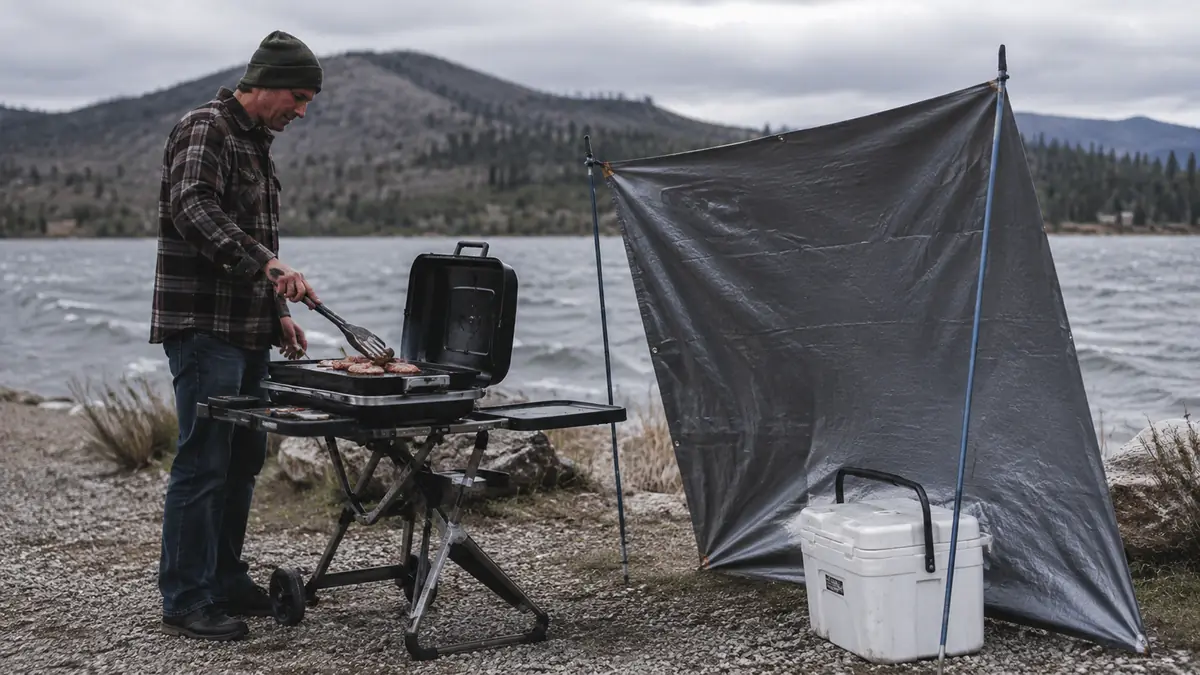
The boat launch afternoon taught me something different. Wide open gravel, no trees, no buildings, just a steady crosswind coming off the water. The outer burner on the exposed side kept guttering, not fully dying but dropping low enough that the grate temperature underneath it fell noticeably. There is no wind guard included on the Coleman RoadTrip 285, which surprised me for a grill marketed at tailgates and campsites, two settings where wind is basically guaranteed. I ended up weighting a folded tarp against a cooler to block the worst of it, which worked, but it should not have been necessary gear I had to improvise on the spot.
The Fuel Math Nobody Runs For You Before You Buy
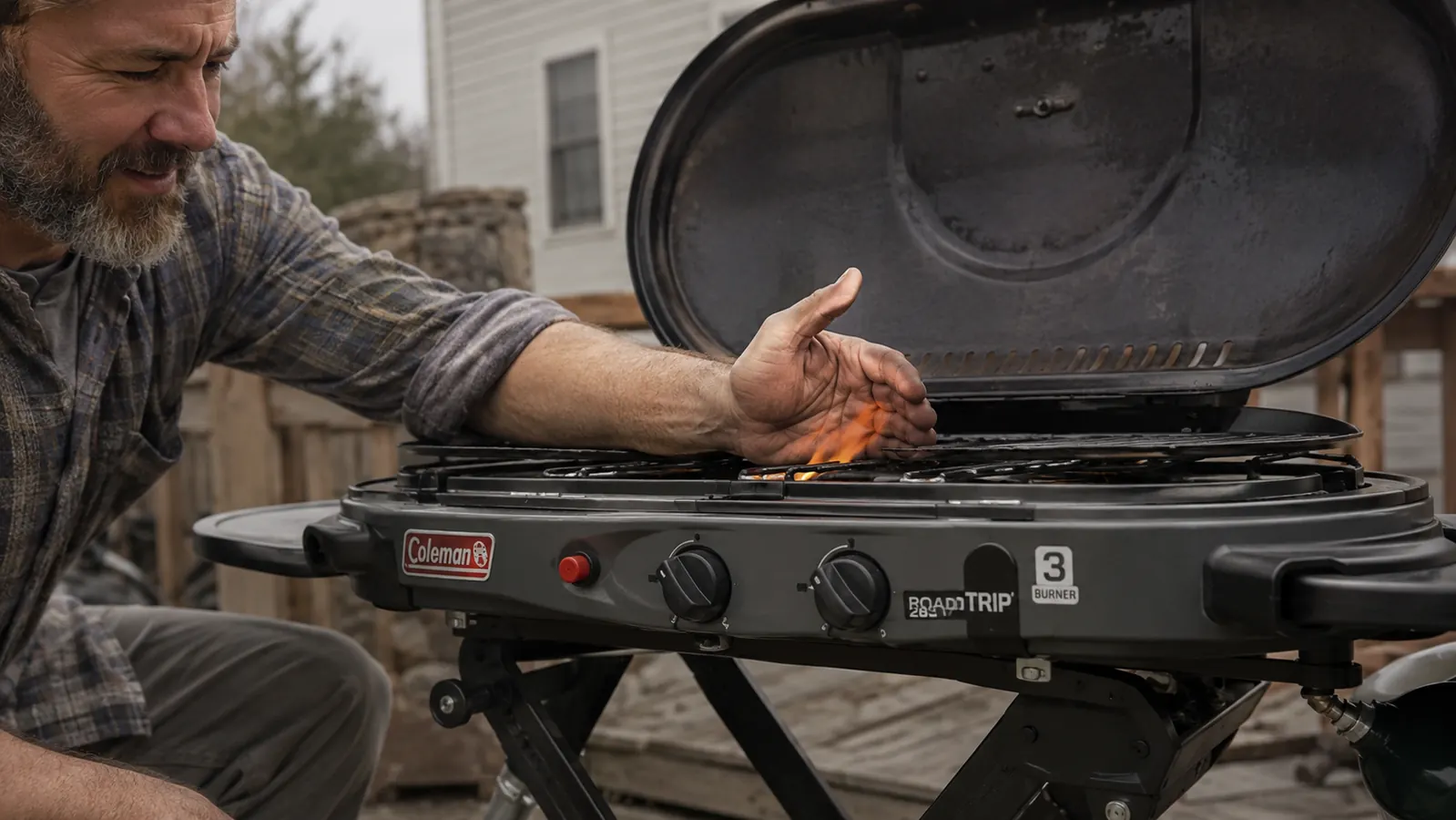
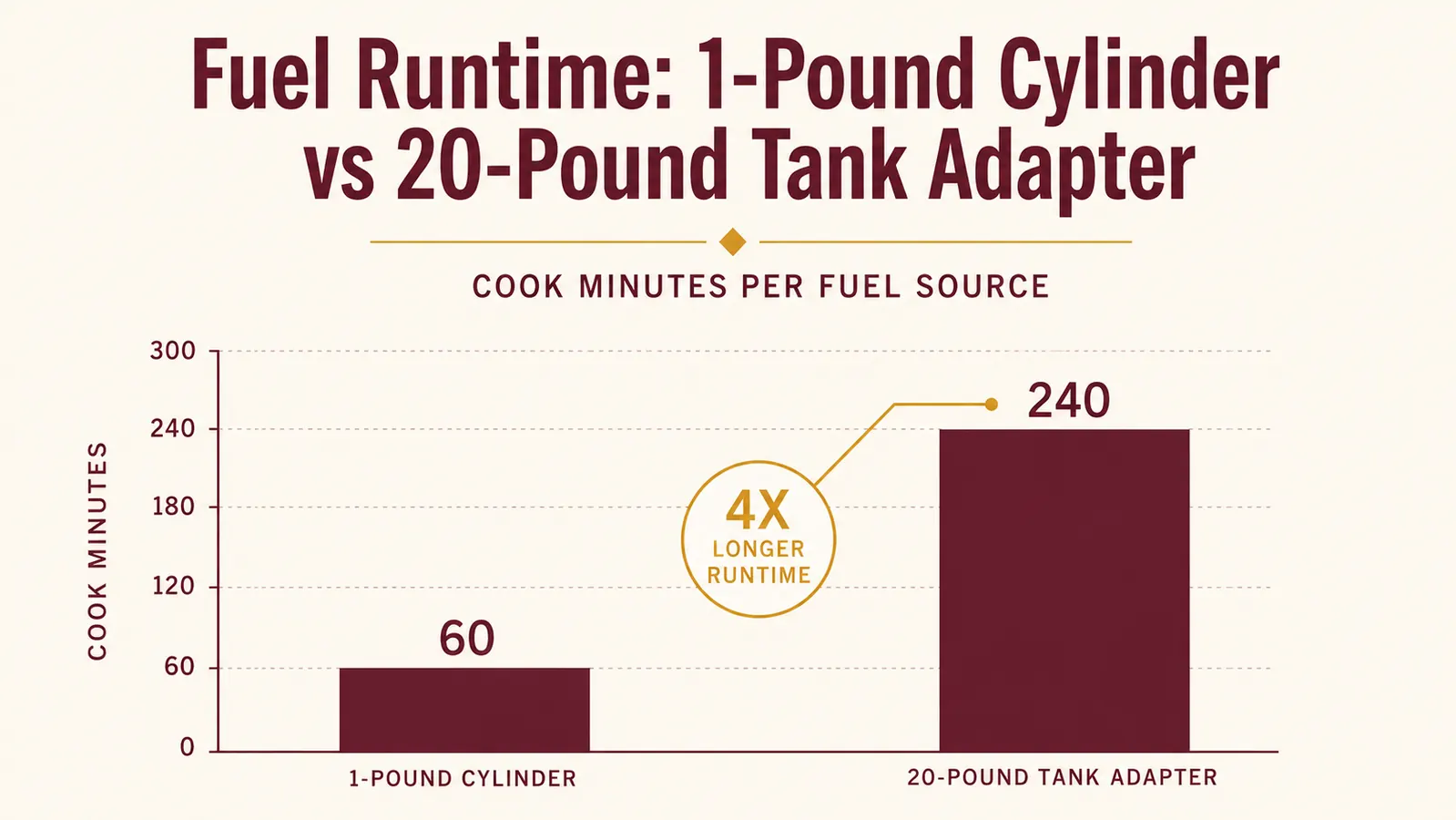
The Coleman RoadTrip 285 is designed to screw a small 1-pound propane cylinder directly into the regulator, and that setup is genuinely convenient for a single quick cook. It is a bad plan for anything bigger. Running all three burners at a moderate-high setting, I clocked a single 1-pound cylinder lasting right around 65 minutes before it started sputtering. That is fine for hot dogs before a two o'clock kickoff. It is not fine for an afternoon of burgers, brats, and a second batch of chicken for a crowd in the six to eight person range, which is exactly the size gathering this grill is marketed toward.
The fix is a separate hose adapter that lets you run off a standard 20-pound tank instead, and once I bought one, the entire fuel picture changed. A 20-pound tank got me through the full four-day camping trip without a single swap, cooking two full meals a day for the group. But that adapter is not in the box, it is not mentioned anywhere on the product page in a way that flags it as necessary rather than optional, and it is one more thing you have to research, order, and wait on before this grill actually behaves the way the marketing implies it will out of the gate.
Do the math before you buy. If you are cooking solo meals or feeding two or three people on an occasional trip, the stock cylinder setup will serve you fine and you can skip the adapter entirely. If you are feeding a group anywhere close to six to eight people for more than an hour or two, budget for the tank adapter as part of the real cost of ownership, not an accessory you might get around to later. I also learned to keep a spare 1-pound cylinder in the truck bed as a backup even after switching to the tank, because the hose adapter itself is one more part that can work loose on a bumpy drive, and I would rather have a fallback than end a cook early over a fitting.
The Weight You Do Not Feel in the Product Photos
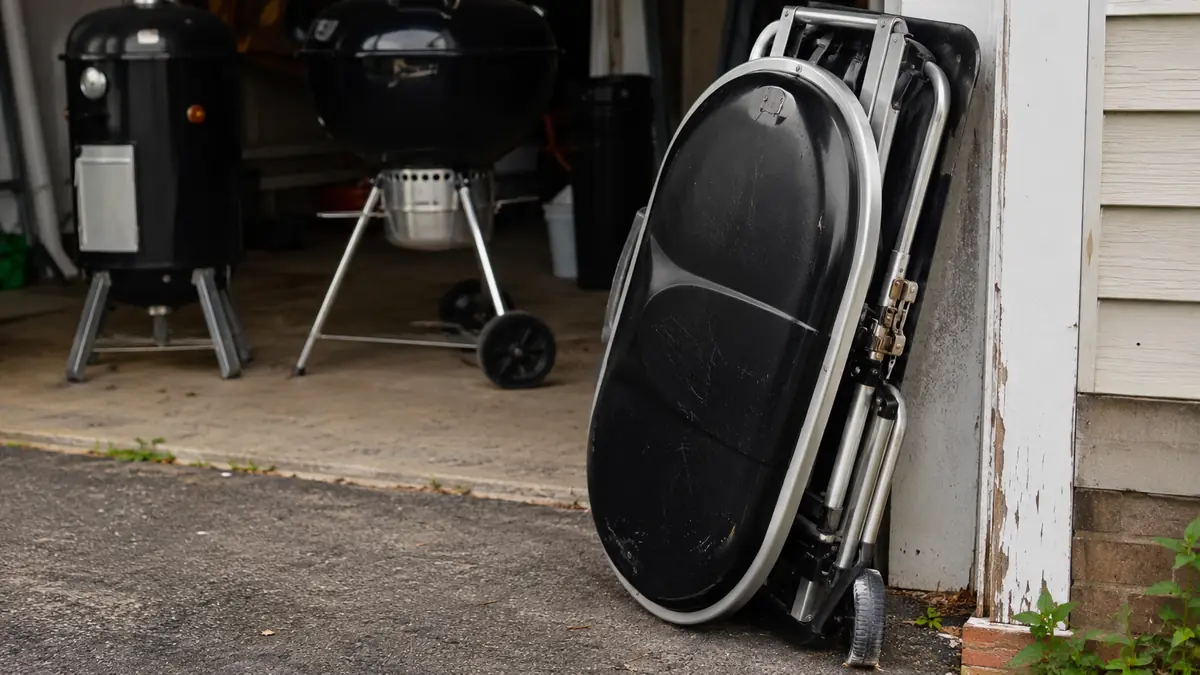
Every photo of the Coleman RoadTrip 285 shows it standing open and cooking, or folded flat and rolling smoothly on its wheels across a clean parking lot. What those photos do not show is what it takes to get it from a garage shelf, down a set of porch steps, and into a truck bed by yourself. This thing is heavy for its size. Folded, it still has real weight concentrated in the cart frame and burner assembly, and carrying it down three porch steps alone the first weekend, I nearly lost my grip and had to set it down halfway to get a better hold.
The wheels are also better suited to pavement and packed gravel than to grass, sand, or the loose dirt you actually find at a lot of campsites and boat launches. At the four-day camping trip, I ended up carrying the folded grill the last thirty feet from the truck to the fire ring because the wheels kept sinking and catching on roots. That is a real limitation for anyone picturing themselves rolling this smoothly across a whole campground the way the name RoadTrip suggests. In practice, plan on lifting and carrying it for the last stretch more often than not.
Loading it into a truck bed by yourself is its own small workout too. There is no built-in handle positioned for a clean lift, so you end up gripping the frame edges and hoisting from an awkward crouch, which is harder on the lower back than the folded silhouette suggests. I have a bad habit of comparing everything to the lid on my 22-inch charcoal kettle, which is light enough to swing one-handed, and the Coleman is nothing like that. If you are cooking alone most trips and do not have a second set of hands for loading and unloading, factor that into your decision, because it is a two-person job more often than the marketing implies.
Small Build Quality Things That Add Up
None of what follows is a single dealbreaker on its own, but stacked together over six months they eroded some of the premium feel a grill in this price range, running in the high three hundreds at current Amazon pricing, ought to have. The built-in lid thermometer on mine reads noticeably hotter than the actual grate temperature I measured with a separate probe, off by close to 40 degrees at a moderate setting. I stopped trusting it by the second month and just use my own thermometer now, which is an extra step nobody should need on a new grill.
One corner of the porcelain grate developed a very slight warp after the camping trip, likely from a hot grate hitting cooler evening air too fast when I closed the lid early to save fuel. It has not affected cooking in any way I can measure, food still sits flat enough, but it is the kind of small defect that makes me wonder how the grates will look after two or three more seasons of the same treatment. And the painted finish on the lid corners picks up nicks and scuffs easily, visible cosmetic wear from ordinary folding and unfolding that a fully powder-coated finish would probably have resisted better.
The grease tray drains fine once it is fully seated, but getting it fully seated took me a few tries the first several times, since it has to slide in at a specific angle that is not obvious from looking at it and is not explained anywhere in the included instructions. Get it wrong and grease pools at the front lip instead of running into the tray, which is how I ended up with a small drip stain on a friend's driveway that I am still a little sorry about. The side latch that locks the legs in the open position also needs a firm push to seat fully, and on two occasions early on I thought it was locked when it was not, catching it before the grill tipped rather than after. It has gotten easier with use as the mechanism has broken in, but a first-time buyer setting this up in a hurry before a tailgate should know to double-check that latch rather than trust it on the first try.
Where It Actually Earns Its Keep
None of this means I regret buying the Coleman RoadTrip 285, and I want to be fair about that after spending this much time on the complaints. Six months in, the hinges and wheels are still tight, nothing has rusted through, and once I planned around the fuel and wind issues, it has genuinely become the grill I reach for on trips instead of a backup I keep meaning to upgrade. That is worth saying plainly, because a review that only lists problems is just as dishonest as one that only lists praise. If you want the full head-to-head against a fixed-cart alternative, I put together Coleman RoadTrip 285 vs Weber Q Series after living with both for a stretch.
The independent burner zones are real, not just a spec on the box, and once you know to run a tank adapter instead of trusting the small cylinders, fuel stops being a source of anxiety mid-cook. I have also come around on the portability itself, once I accepted that the last thirty feet sometimes means carrying it rather than rolling it. For the specific job of getting real two-zone propane cooking to a tailgate or a campsite, the Coleman still does that job better than anything else I tried at a similar price band, and I wrote about that case in more detail in this piece about how it changed our tailgate setup.
What I Liked
- Independent burner zones hold real, separate heat once you know how to use them
- Hinges and wheels have stayed tight through six months of loading and unloading
- Runs cleanly off a 20-pound tank once you buy the separate adapter
- No rust or structural issues after repeated hauling and rough handling
- Folds compact enough to fit behind a truck's back seat
Where It Falls Short
- Stock 1-pound cylinder setup burns out in about an hour under real cooking load
- No wind guard included, and an exposed burner will gutter in steady wind
- Heavier to carry solo down stairs or across soft ground than the photos suggest
- Built-in lid thermometer reads well above actual grate temperature
- Tank adapter is effectively required for groups but sold separately
The grill did not fail me at that boat launch. My assumption that it would just work the way the box implied is what failed.
Who This Is For
This makes sense for someone who is willing to treat the 20-pound tank adapter as a required purchase, not an optional accessory, and who is realistic about carrying a folded grill the last stretch of dirt or grass rather than expecting it to roll smoothly the whole way. If you cook for a group in the six to eight person range on tailgate lots, campsite pull-ins, or driveways without an outlet, and you go in with your eyes open about the fuel setup and the missing wind guard, the Coleman RoadTrip 285 earns its keep. It has become the grill I actually reach for on trips, not the backup I keep meaning to replace, and it usually rides with a second person along to help with the lift, which I would recommend to anyone in the same boat.
Who Should Skip It
Skip this if you are buying based purely on the unboxing photos and expect a smooth, effortless experience with no extra purchases or improvising. Skip it if most of your cooking happens in genuinely exposed, windy spots like open fields or waterfronts, unless you are prepared to bring your own wind block every time. And skip it if you cannot commit to buying the tank adapter, because running the stock cylinders for anything beyond a quick solo meal will leave you frustrated and reaching for backup fuel mid-cook, the same spot I found myself in at that graduation party.
Now you know the parts the five-star reviews skip.
The Coleman RoadTrip 285 is still a genuinely capable portable grill once you plan around its fuel setup and its missing wind guard. Check today's price and current availability on Amazon before your next trip.
Amazon See the Coleman RoadTrip 285 on Amazon →